

“It’s about the missing priest.”
“He’s not missing, the guard said, looking puzzled. “He’s over there by the paddock. He turned to salt.”
(Note for posterity: I didn’t have a big family vacation scheduled to preserve my streak of always having a new Natasha Pulley book to read for such events, but my sister was visiting us when I bought the book, so I’d say that still counts.)
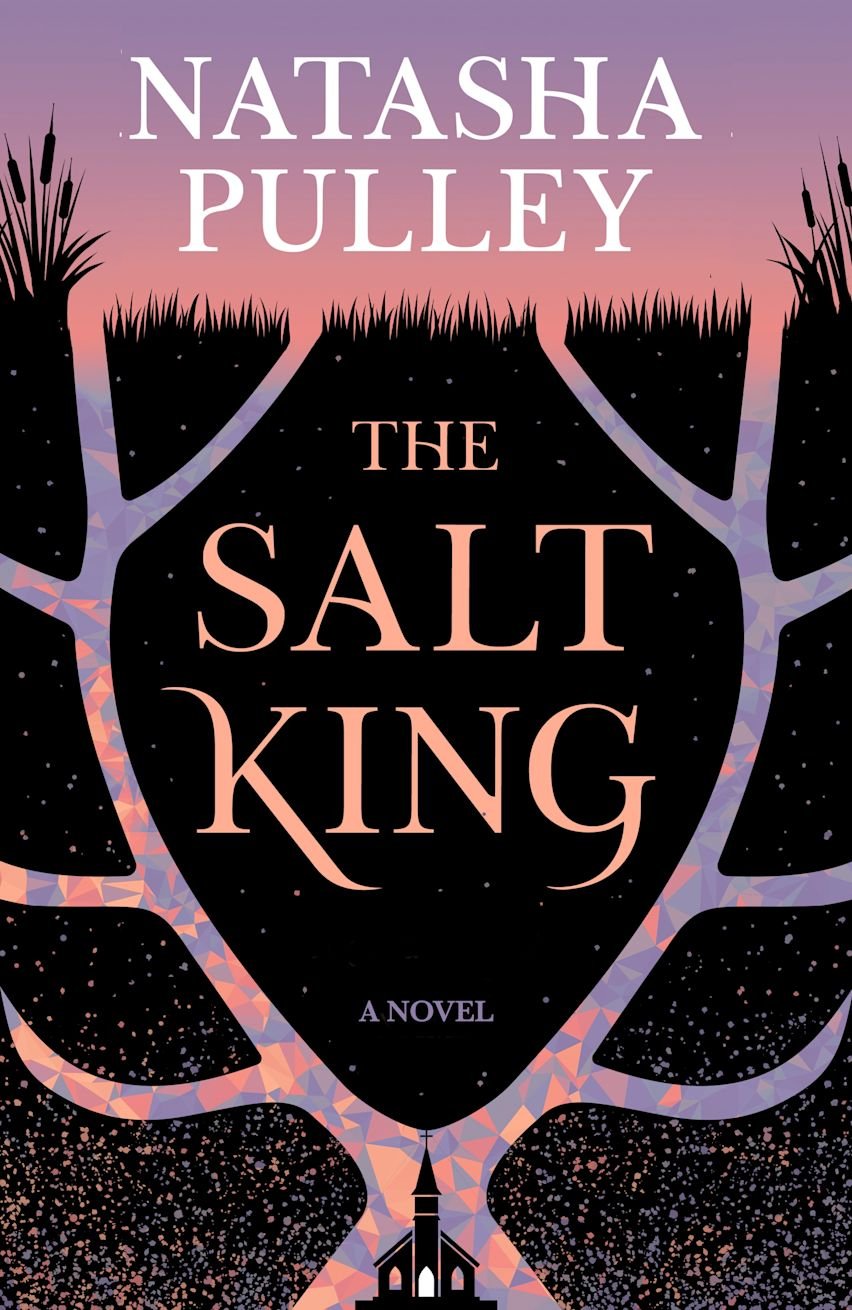
It’s not AI, or some other kind of deepfake. As far as anyone can tell, the video of the influencer-priest turning into a pillar of red salt is absolutely real. It happened in the tiny village of Hreodwater, which also happens to be the location of several also apparently real incidents of people being healed from lifelong conditions like rheumatoid arthritis. Or a severed spine. The Vatican has to investigate to see if they’re looking at an actual miracle or…something else. The best (and possibly only) candidate for the job is a young Jesuit priest who can speak the famously difficult language of Hreodwater because he was born there.
Avelyn Brocken has devoted the last twelve years to the Church. He’s cold all the time, food doesn’t taste like anything, and he’s never felt any sense of awe and belief in God that other priests feel. Despite all his attempts, he’s never stopped missing the overwhelming feeling of love for the Salt King – the god of Hreod – that he and his whole family grew up with. And more than anything he really, really, doesn’t want to ever go back.
…please could he just be sent to a war zone to be shot at in an aid convoy, or, you know, burned relaxingly at the stake?
The setting for each of Natasha Pulley’s books has been about as different from the previous one as you can imagine. And one of the things I love the most about her writing is getting dropped down in the middle of that setting and seeing how everything works. Hreodwater is a matriarchal society in a tiny village with a language that hasn’t changed in millennia, and which has somehow managed to be its own country separate from the UK, with ancient customs and almost hilariously mundane attitudes towards interest rates and mortgage markets, and it’s all described with Pulley’s wry prose and delightfully tongue-in-cheek footnotes. (Apparently the Hreod legal title for the King of England ends with “Except Hreodwater, Where He Is Very Welcome If He Is Not A Nuisance”.) The thing that sets Hreodwater apart from everyone is salt. Specifically halite, salt crystal. The town is part of an enormous salt mine, and halite of every color is mined there and used by the town in all sorts of interesting ways. Statues, building material, multi-colored glass in the window panes, decorative beads woven through the more-well-to-do citizens’ hair. Even snails in Hreodwater build their shells from translucent salt instead of calcium.
But the most important property of the salt is something only the people from Hreodwater can see: all the halite glows in what is known as Salt Light. For someone who’s Hreod, the unlighted mines are a glorious explosion of light and color. The salt light drifts like fog, doing weird things to the weather, dissolving clothing and tools, completely frying anything electronic with an explosion of salt crystals, and growing a grove of oak trees underground, with acorns like pearls. And now it’s apparently healing visitors to the village’s abbey, and Avelyn’s job is to determine if this is an actual blessing, or something terribly dangerous and wrong.
Avelyn heard the snatch of a hymn that had never been sung to any god so new as Christ.
All hail, He wakes…
Avelyn is the perfect person to introduce us to Hreodwater, because he spent sixteen years growing up in its unique, salt-based society, but he’s been away long enough that he’s having to rediscover a lot of things he’s learned to dismiss as a well-meaning but ultimately delusional cult. He cares deeply about the church, and can discuss at length how criminal it is that most people don’t realize how brave and clever Jesus was being every time he ran philosophical circles around his enemies. And at the same time he can see very clearly that the Catholic Church has A Lot of Problems. Oh, and as kind as he can be to just about everyone, Avelyn adores conflict, especially if he gets to be the one to start it. It’s always fun to watch, he doesn’t have a problem with cheerfully telling some smug priest to fuck off with his warnings about women in the priesthood. He also loves a good argument, especially when he’s been good all day so now he can drive somebody unpleasant into an impotent rage. As a treat.
“What, that’s it?” Reyes said, indignant.
“Yes. This is an inquisitorial investigation into a miracle, but you won’t answer the questions and I don’t like you.”
I always enjoy the way Pulley writes dialog, and she’s created a host of interesting characters to deliver it, with the chapters jumping back and forth between viewpoints. There’s Jericho Calder, the handsome self-deprecating doctor at Hreod who develops an instant rapport with Avelyn, creating moments of affection that he plans to treasure forever (as a priest, Avelyn has to save these moments up in lieu of, you know, actual romance), and who has a calm, empathic way of poking holes in some of the ickier parts of Christianity (like God smiting entire cities, children included. Or how it forces believers to be okay with the fact that they’ll go to heaven and all their loved ones will get to stay in hell forever if they don’t believe the exact same things in the exact same way.) The two of them become something like partners in crime with the visiting blind nun Annunciata who’s never met anyone she couldn’t scandalize.
We also have a strange salt-bloom in the middle of the Dead Sea being investigated by two scientists, one of whom is a middle-aged violinist with occipital epilepsy who prefers the off-and-on hallucinations of lions and astronauts to the medication she would need to stop them. She also has to keep reminding herself that having a crush on her twenty-something colleague is really inappropriate. Their conversations are a study of two people who live for learning new things about anyone, and the scene with an impromptu violin performance of Christmas music in the middle of the desert made me smile.
And of course there’s Father Li, the elderly Catholic priest who tanked his career at the Vatican by absconding from Hreodwater with a traumatized sixteen-year-old who was convinced that the event which killed his entire family was all his fault. And no, there’s no evidence of abuse whatsoever. Avelyn adores Father Li for saving him, and has done his best to follow Li’s advice to look at everything he grew up believing about the Salt King as just myths and superstition. Right up until those myths and superstitions start affecting the rest of the world in ways that look an awful lot like the apocalypse.
And oh, what an amazing apocalypse it’s shaping up to be. It starts with coin tosses always coming up heads, and then walks the reader through the ways that something like this will rip apart the very fabric of civilization. Salt mines around the world start doing very strange things, there are devastating scenes of crystals exploding from any kind of machinery, and the whole world learns a new word: halify. Some of the scenes feature an epic, horrifying disaster; some of them are painfully small, like the lonely tragedy in the fog and snow. The technique of using silver to protect cameras and phones means even non-Hreod can see the shapes in the salt light, which start out as something with wheels and wings and faces, but which gradually turn into whatever the viewer believes they’re seeing.
The concept of belief is at the core of this book: belief as control, as identity, as religious truths that somehow always match up with what the religion’s creators already believed. And the biggest question about belief that the book asks is something that, depending on where you’re standing, can be either comforting or terrifying: what if we’ve gotten all of this completely wrong?