

“What better time to listen to a story than when the world is about to end?”
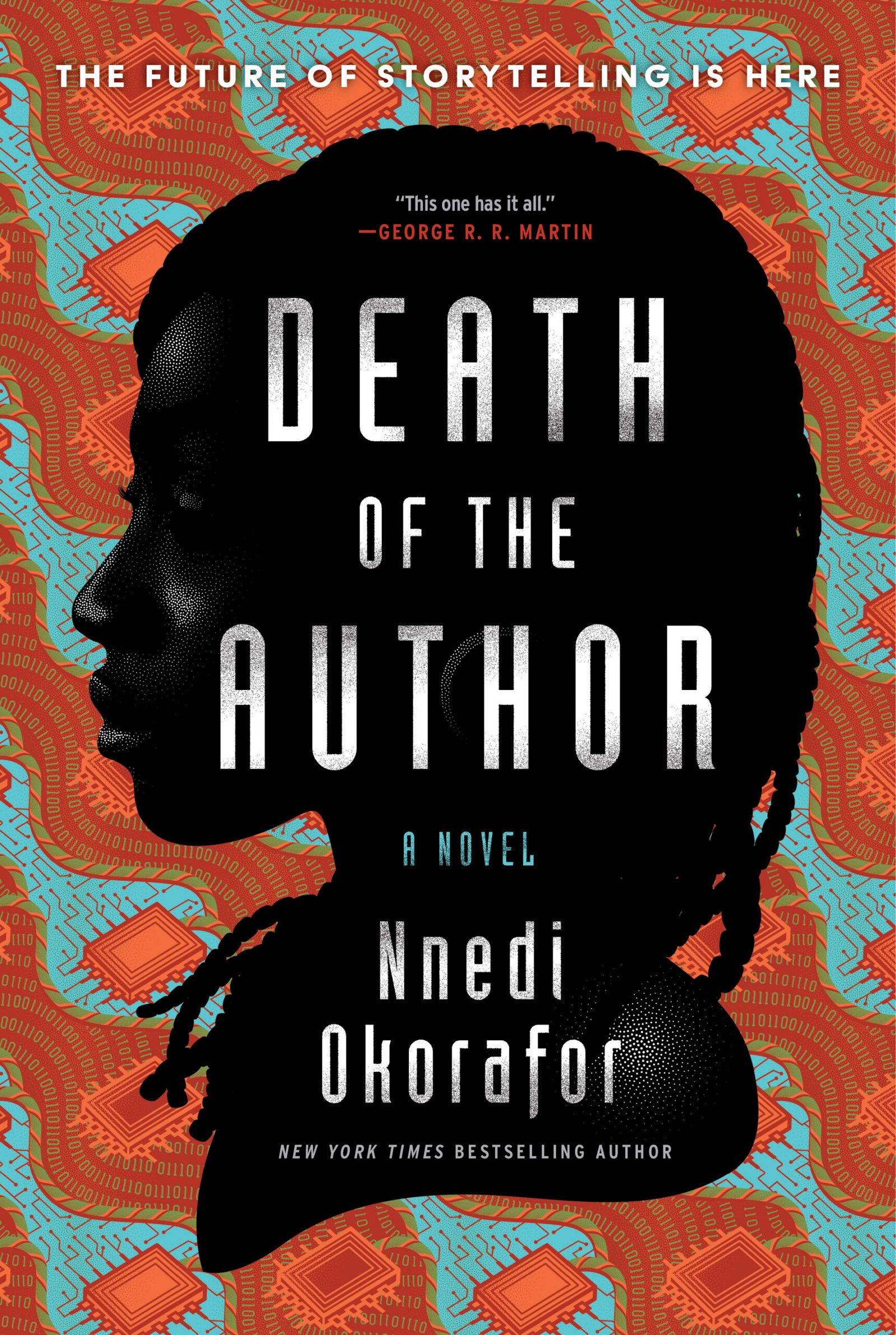
It’s the last of the main Hugo-nominated fiction entries – just in time for the award ceremony on August 30 – and what a nominee to finish up with! Nnedi Okorafor’s novel is an Afrofuturist, robot apocalypse, wild family drama, dancing around the themes of family, identify, origin, family, grief, the meaning of being human, the importance of telling stories, the hazards of gaining celebrity status as an author, and in case I haven’t mentioned it yet, family. And through it all, the main character Zelu doesn’t have the least ambition for anything other than becoming as much Zelu as is humanly possible to be.
We’re introduced to Zelu at her younger sister’s wedding in Trinidad and Tobago, surrounded by members of her extended family (Yoruba royalty on her mother’s side, scandalously not Igbo royalty on her father’s side). She’s doing her best to ignore the judgy side-eyes from the fact that she’s a paraplegic (due to an unfortunate tree-climbing accident when she was twelve), creative-writing teacher (instead of a lawyer or doctor like her siblings), and – gasp! – completely uninterested in marriage. Her plan to enjoy the celebration anyway is put to the test when she gets word that she’s been unceremoniously fired from her university job. And her novel has just gotten its tenth rejection, which means her hopes of getting it published are pretty much destroyed.
Not one to ruin her sister’s day (or let bad news get the best of her), Zelu attends the ceremony, stuffs herself with a variety of African and Caribbean food and drink, has a very satisfying one-night stand, gets unbelievably high, has a good cry, and then sits down at her laptop late at night and writes a book that completely changes her life.
She wrote about those who weren’t human. She wrote a world that she’d like to play in when things go to be too much, but which didn’t exist yet. She wrote something else, something new.
She wrote about rusted robots.
The main character had all my sympathies from the first page, but Okorafor also makes it very clear that Zelu is…kind of a lot. “Impulsive” really doesn’t cover it. She’s had decades of learning to work around her disability, the panic attacks that the accident left her with, and the general feeling that she’s always going to be a disappointment to her loved ones. So what the hell, she charges through life like a runaway train. Quick-tempered, never backing down to the blunt comments from her patriarchal extended family, stoned often enough to scandalize her siblings, cheerfully hooking up with a series of men who she also cheerfully kicks aside when they get too clingy. Even the book she writes is an impulse, done with no intention of sharing it with anyone, a science-fiction novel when she doesn’t even like the genre. And yet somehow the story of a robot civil war in far-future Nigeria resonates with millions of readers. The novel makes her rich. It also makes her famous. She becomes quite a phenomenon, a Nigerian American paraplegic woman who’s debut novel of robots trying to save a post-humanity world has become a runaway success, and it catches the attention of a scientist, one who offers Zelu a brand-new technology that may help her walk again.
And Zelu’s family is standing nearby through all of it. WHETHER SHE WANTS THEM TO OR NOT.
Her oldest sister unleashed the demons first. “Zelu, what is wrong with you? Do you care about this family at all?”
Zelu’s relationship with her family is a series of heartwarming moments trying to drown out all the truly combative ways everyone reacts to anything Zelu does. To be fair, Zelu has always been kind of a lot, and her accident was life-changing for everyone. It also looks like Nigerian culture has the same condescending, dismissive attitude to people with disabilities (and their families) that most other cultures have, they’re all just a lot more open about saying things about it. But the way Zelu’s family reacts to her doing things that might actually make her life better is endlessly infuriating. They at first think she’s stoned when she announces her successful book, and they seem mostly baffled and annoyed by the attention when the book does really well. They’re utterly horrified when she tells them about the new technology that may help her walk, to the point where they’re shouting at her for being selfish and come this close to dragging her wheelchair back into the house as she’s leaving. I lost count of the number of times where, if I’d been Zelu, I would have held something they said against them for the rest of their life, or maybe have been just “Okay, the hell with y’all, peace out” and walked away forever.
And yet that never happens. Okorafor never even implies that that should have happened. There’s no cutting off contact for life, or laying down boundaries, or doing anything to shape her siblings or parents into more acceptable and accepting people. Because this is family. Throughout the book they rage, but also laugh. Argue, but come together to celebrate, or grieve, or lash out in pain and then bond over Ankara fabric or jollof rice or stories about where they’ve been personally but also the nation where they’ve come from. And yes, they can say unbelievably hurtful things, but they’ll also sleep by a hospital bed and cook comfort feasts and do battle against harassers with a flawless barrage of scolding or just a handy canister of mace.
There are interviews scattered throughout the book, all very vague about why Zelu is famous enough to have family and friends interviewed, and all distressingly referring to Zelu in the past tense. I thought at first that it was a deliberately comedic choice to have the interviewees spend more time talking about themselves than about Zelu. And it may be, but it also makes sense because these people are part of what makes Zelu who she is. And in many ways Zelu has shaped who they are, just like how she’s shaped her life and the rest of the world with her novel.
Zelu’s book Rusted Robots isn’t just something that’s mentioned; the whole format of the novel is a story-within-a-story where we get to see a type of robot known as Humes trying to preserve the stories of the long-gone humans, and then trying to save the Earth from a planet-destroying disaster. And this is happening while a faction of bodiless AI’s are working to erase all Humes from the face of the Earth in an attempt to wipe out the last remnants of human culture. The worst of tribalism is on display, but the kill-or-be-killed madness is put on pause when a Hume named Ankara is thrown together with a rare solitary AI. Both of them are forced to learn the value of each other, all in the dreamlike setting of the lush overgrown ruins of Nigeria, surrounded by robots in the shape of animals, and dust clouds of purple pollen, and an oncoming army flying through space bringing pieces of the sun. It’s a story I would love to see in movie form, and I’m sure Zelu would too, since the actual movie adaptation she gets is something that strips out everything Nigerian from the book along with pretty much everything she wanted the story to say. And the worst part is everyone loves it.
The capitalism machine had used her book, her attempt at shouting into the void, to make visual comfort food for drowsy minds.
Zelu reacts to the butchering of her story, and family conflicts, and unwanted fame, and cancel culture, and violence in her country of origin, and everything else that gets thrown her way with fury and laughter and panic attacks and a spirit that’s definitely dented but completely unbroken. I may not agree with all her choices, but there is something admirable in a person who refuses to turn down her volume just to keep other people comfortable. It’s an attitude that takes her story from Chicago to Lagos to outer space as the theme of storytelling blurs the line between dreams and memories, her book and her world.