

Robert Jackson Bennett returns with another installment in his award-winning series featuring the detective Ana Dolabra and her long-suffering assistant Dinios Kol. The third book in the series involves one of the weirder murder tropes: the murderer who was caught red-handed and seemingly has no explanation for why he committed the murder in the first place.
It all starts with a family feud. The Armentas and the Buravs have been jockeying for power in the Sapirdad canton for decades, each side taking turns making the most money in the canton’s honorable industry of “keeping the Empire supplied with meat”. When the heir to the Armenta fortune and the youngest daughter of the Buravs start a passionate affair, it sounds like the triumph of love over family conflict. And then Castus Armenta murders Zansay Burav, butchering her like one of his family’s prize cows. That’s not a spoiler, it’s what Ana and Din are sent to investigate at the start of the book. The investigation is partly to try to find out why Castus murdered his lover, but mostly to prevent a full-blown war between the families which could *gasp* reduce the amount of beef exports a few percentage points. Okay, maybe more than a few. It’s making Ana even more irritated than usual because it’s all so boring.
Two lovers, from two feuding gentry clans, meeting secretly under false names for their tryst!” She scoffed. “How puerile. How derivative. I pray it is more deviant than it appears.”
Fortunately for Ana and unfortunately for everyone else, the case is a lot more complicated than that. And not just because of the method of the murder. There’s quite a few things going on in Sapirdad; family alliances, family inheritances, and family curses. Livestock that have been engineered by the Apoths to be bigger and/or intelligent enough to put to work on their own, echoing the engineering that’s done to create Sublimes like Din who’s starting to worry that he’s not even human anymore. And everyone tries to not think about the fact that the entire canton is right up against forbidden groves created by the long-disappeared Khanum who began the whole process of using Leviathans to shape themselves and their world into convenient things.
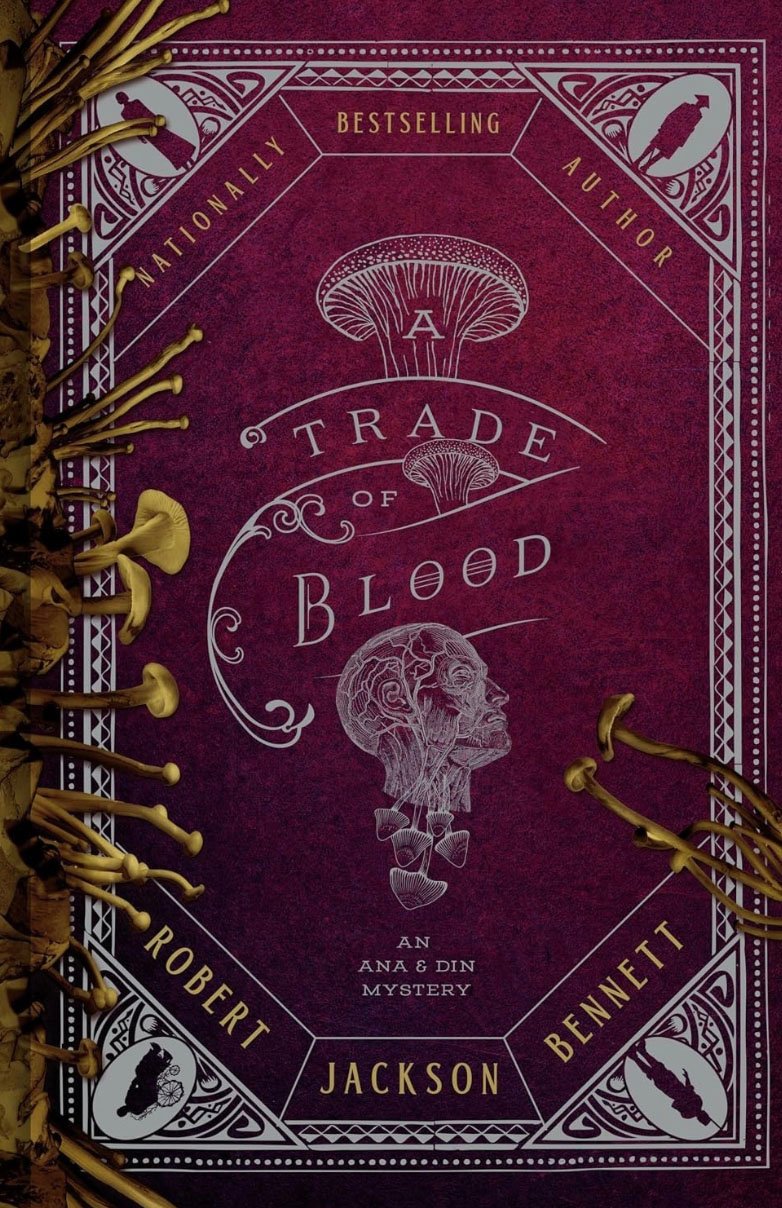
The more we see of the Empire, the weirder the Leviathan-derived technology gets. And even though so much of the animals and plants and the basic building blocks of life have all been fine-tuned to serve humanity – and thus, the Empire – not all of it feels, well, safe. Eerily beautiful lights that are made out of fruiting vines with glowing larva, and houses that are grown out of fretvine are one thing; house-sized cows called urhosi, and impossibly slender, long-legged horses known as destriers are quite another. Bennett’s descriptions are a fascinating mix of Lovecraft and Salvadore Dali. Things like the cat-sized (but definitely not cats) human-handed creatures who pick the startling amount of food needed to feed the shocking tonnage of cow flesh needed to feed the Empire are a disturbing idea, but they appear often enough to almost get used to them. But Bennett will still startle you out of nowhere with images of tiny mites set loose on a burn-victim’s flesh, tree branches that interlock in ways designed to be unsettling, or all the strange ways that autopsies can be done with plants that are trained to work on their own.
“What he will do is instead entice threadvine to do these tasks for him,” said Ana. “A type of fretvine, but one specifically for rending flesh and bone…”
I never get tired of how opinionated, irritated, abrasive, and completely devoid of empathy Ana can be, especially when she’s focused on some horrible way a person can die, or that their body can be pulled into pieces afterward. Still a genius, verbally abusive – especially to Din, who’s dry responses to that are always funny – she’s still going around blindfolded to avoid overstimulation, and that’s when she’s not freaking people out by locking herself in a closet or a handy traveling trunk for a few hours. Believe it or not we don’t learn a lot more about her origins here, even after the revelations that were hinted at in the end of the last book.
No, the real focus in this book is on Din‘s life. Remember, he volunteered to become a servant of the Empire to pay off his late father’s crushing debt, and also occasionally send money to his poverty-stricken family. And yet we’ve gone two whole books with zero communication with his family. This is where we find out what all that is about. Din’s been holding on to some resentment for what he’s had to sacrifice, and that’s only gotten worse now that he’s starting to feel the irreversible effects of a job that lets him see horrible things with an altered brain that means he’ll remember all of it, in perfect detail, for the rest of his life.
How many years of sanity do I have left? Twenty? Thirty? I did not know, but I felt as if a tremendous hourglass had been turned over within me, and each grain tumbled down with the crash of a boulder.
There are still a lot of humorous moments in this series, like a drunken reunion with family members, or Din wearily encouraging a villager to just blame Ana for everything up to and including natural disasters if it made things easier, or Ana verbally ripping a strip off her assistant for once again getting involved with a beautiful male comrade who is probably not to be trusted. Din. But on the whole things are getting darker and more dangerous as we sink further and further into a world that’s being shaped by the blood of monsters. And now somebody is willing to use a nasty new technology to get what they want, which could be making their family the “winners” in Sapirdad. Or it could be revenge. Totally meaningless, hollow revenge at this point, but at least it’s something.
YOU SAY WHEN THIS IS DONE, ALL WILL BE FORGIVEN. YET I NO LONGER BELIEVE IN FORGIVNESS – FROM YOU, OR ANY GOD. I WILL FIND YOU IN THE AFTERLIFE AND BRING ETERNAL TORMENT WITH ME. THIS I SWEAR.
What we get here is a sense of escalation, of things getting more and more dire, and the Author’s note indicates that some of this is at least an echo of what’s going on in our current reality. (This doesn’t lead to a rant against the meat industry, although there are certainly a lot of big issues that really should be addressed.) The problem in Sapirdad is that the Empire has decided it wants one commodity – meat – badly enough that it will pour endless resources into getting it, turning entire acres into bloody swamps of all the organs and bones they don’t use. The ridiculous amounts of money from the industry gets grabbed up by fewer and fewer people, until it’s two families who have everything, which is still not enough, and now the entire Empire could be crippled by one supply chain disruption. And trying to defend any of this as “but we’ve always done it this way” rings a little hollow, especially in an Empire where always goes back centuries to a race of technocrats who probably didn’t have had everyone’s best interest in mind, and may have all kinds of leftover projects lurking in the dark.