

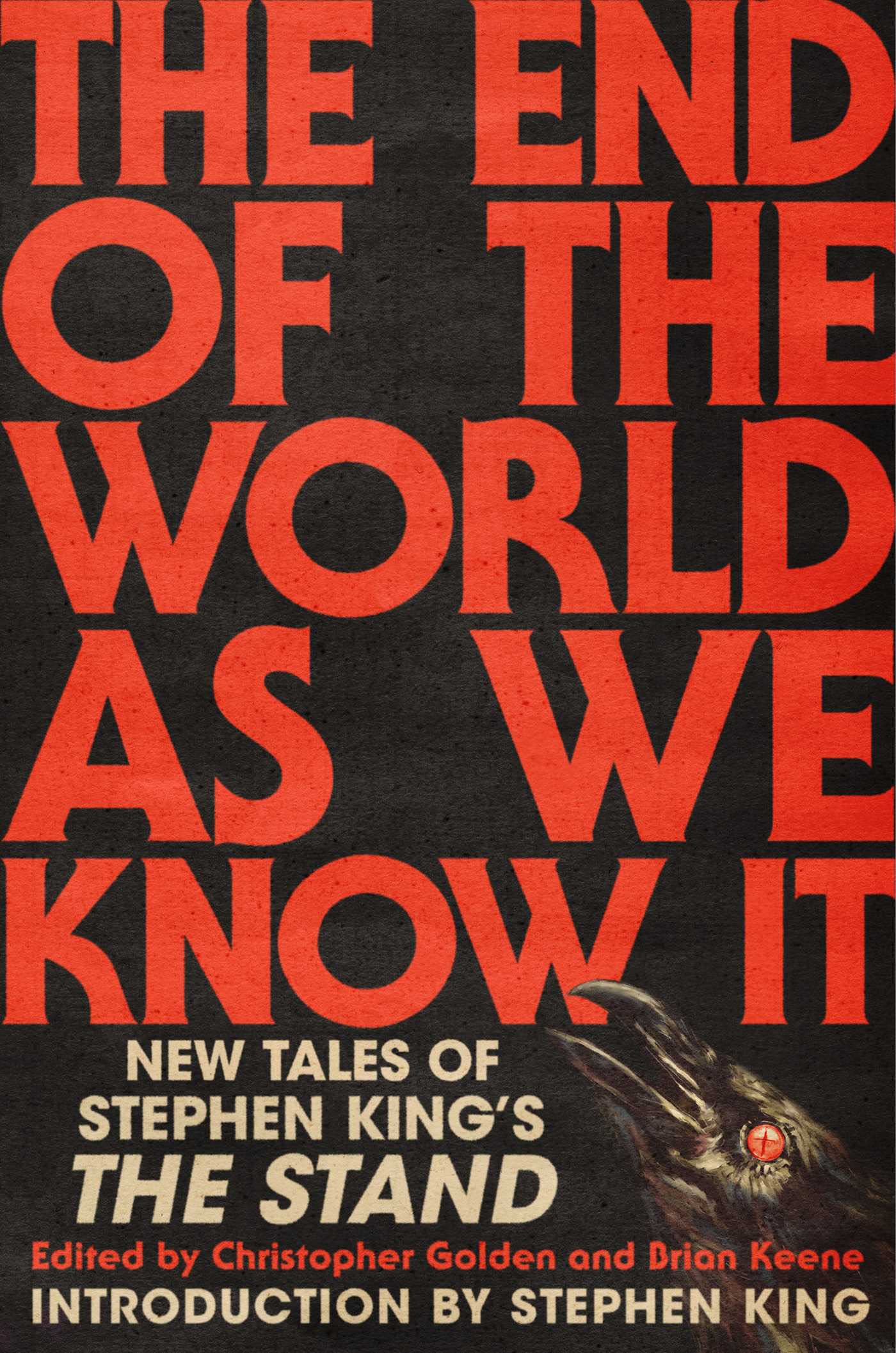
It took me way too long to finish this (no joke, I bought this book last December), but I started reading it again at the beginning of the month and got it done in time to have a review right before Halloween. Thirty four short stories set in the beginning, middle, and aftermath of the world-wide pandemic from Stephen King’s The Stand. Strap in, because this review is going to be long, and these stories? Are grim.
For anyone who hasn’t experienced The Stand – either the original book, the complete and uncut edition, or the two TV mini-series adaptations – here’s the very briefest summary. A government-engineered version of the flu nicknamed Captain Trips wipes out 94% of the human population. The surviving humans are left to deal with the fall of civilization and everything that comes with it. And to make matters worse, people have started dreaming about (and are drawn to) either a kindly elderly woman in Nebraska, or a terrifying figure in Vegas (known as The Dark Man, The Walking Dude, or Randall Flagg), and it’s pretty clear that one of these people is trying to save the world and the other is trying to finish the destruction.
The occasional character or a particular song from The Stand wanders in and out of these stories, but for the most part it’s entirely new characters dealing with the End of the World in their own unique ways. With so many different authors in this collection, you’re going to get completely different viewpoints on the apocalypse and on what humanity is capable of, hopeful, cynical, or outright despairing. What (I imagine) is central to all of the stories is the authors asking themselves: what part of Stephen King’s apocalypse scares me the most? Is it losing all the comforts of civilization forever, not to mention the pesky necessities like having enough food, or not dying when a puncture wound gets infected? Is it the fact that the worst people can now indulge in their worst impulses with nobody around to stop them? And sure, dying from a pathogen that leaves its victims clawing their throats and drowning internally is awful. But is it actually worse to have to go on after that happens to everyone you love except you?
The collection is divided into four parts that can roughly be described as Beginning, Middle, After, and Weird. Part One: Down With The Sickness is the longest (almost half the book), and in my opinion it’s also the hardest to get through. These are the stories of people looking back on everything they just lost, or in some case are still in the process of losing. And not just losing humans. If stories of animals make you cry, then be warned about “The African Painted Dog” where members of the proud species HereWeCometotheEnclosureofLycaonPictustheAfricanPaintedDog are left to navigate a world with no more artificial habitats. Also in this category is “Lenora” (which will make you wonder just how much grief the human body can withstand) and “Every Dog Has His Day”, with heartbroken teenager Corey who’s lost his dog on top of the rest of his world (this story has the benefit of having one of my favorite closing lines in the collection).
Some stories are just extensions of the character’s existing madness or trauma, with the pandemic as backdrop, like Police officer Abel and his desperate loneliness and his problematic attitude toward women in “Room 24”, or Desi Calderon fleeing a terrifying relationship along with her tiny son in “La Mala Hora”. Quite a few of the stories portray the worst in humanity, like ten-year-old Malik’s low-income neighborhood being torn apart by the people who only want those who dreamed of The Walking Man to survive in “The Tripps”, or the residents of Seacliff taking “protecting their community” to insane places in “Lockdown”. On the opposite end of the spectrum there’s a retired police investigator deciding that even in the apocalypse there needs to be someone to find justice for murder victims in “Kovach’s Last Case”.
The stories can be as everyday as the widowed Sandra navigating a four-hour walk through her crumbling Puerto Rican community for a whisper of a chance in “The Hope Boat”, or as otherworldly as the last moments of the astronauts trapped onboard the Space Shuttle Discovery in “Grace”. And I don’t quite know what to think about Poppy Z. Brite’s “Till Human Voices Wake Us, And We Drown”, with an orphaned teenager with his pre-existing infection, and his elderly seaside neighbor with something weird in a fish tank.
My favorite from this section would have to be C. Robert Cargill’s love letter to horror movies, “Wrong Fucking Place, Wrong Fucking Time”, with two former ranch hands who’ve done what they can to clean up the bodies in their truck-stop town, and then created their own alternative to civilization. Because, if the generator’s still running, and you live next to one of the biggest collections of VHS rentals in the area, and you have beer, then why not make every night Friday Movie Night?
Part Two: The Long Walk takes us further into the pandemic, and into the war between good and evil. The stories here don’t actually get us to Vegas or Nebraska, but a lot of the characters have finally made the decision about where they’re going.
Not that everyone can really put that goal into words. And not everyone will actually succeed. The slacker Lev from the story “I Love The Dead” has made it his life’s goal to locate Jerry Garcia in San Francisco and give him his severed finger back. Because reasons. “Milagros” is a dark depressing story that doesn’t seem to have a lot of faith in the concept of faith. In “The Legion of Swine”, Woodrow is still grieving the loss of his wife and children when he’s forced to reckon with servants of The Walking Dude, and the questionable loyalty of pigs. Paul Tremblay’s “The Story I Tell Is The Story Of Some Of Us” is another one of my favorites; it’s narrated by a wisecracking woman telling a story by the campfire, about a friend who wouldn’t choose between Vegas and Nebraska, and all her wistful regrets at how that turned out.
“Keep The Devil Down” is a straight-up thriller, a game of cat-and-mouse as Elise flees from her origins and a supernatural muscle car that chases her and her young companion across Arizona. By contrast “The Boat Man” is an odd, almost slice-of-life story of a pre-teen girl and her ten-year-old friend who have to depend on the help of a questionable stranger to get from Key West to the mainland. This is one of several stories that I would have liked to actually follow a little longer, since the adventure doesn’t end so much as just stop.
The collection also gives us a taste of what was happening in other parts of the world during and after the super flu. “Across The Pond” is set in deserted London, and features a sullen, bitter woman who has a lifetime’s worth of resentment at how her life has turned out, and a very unhealthy lust for her dreams of Randall Flagg. Flagg is either absent in “The Mosque At The End Of The World”, or his influence is simply there to make horrible people worse, as a ragtag group of survivors, a blind imam, and his dog, try to rebuild something good on the outskirts of Lahore, Pakistan. (This one can also be added to the list of Stories With A Perfect Final Line.)
If you’ve ever finished The Stand and wondered “then what happened??” then Part Three: Life Was Such a Wheel, has some theories. This is my favorite section of the book, and I’m not sure why because these aren’t particularly hopeful. Most of them feature some example of Man’s Inhumanity To Man, usually in the name of “atonement”. There are not one, but two stories where some unfortunate mutations in the super-flu have killed the next generation of children, and possibly sterilized most of the survivors. “Hunted To Extinction” is a terrifying monster story, with something that’s not only hunting the residents of a small town, but it’s also getting into their brains and making them…do things. “He’s A Righteous Man” is in a way even scarier. People will do all kinds of things if they think it will save them from what they think is a punishment for their sins, but I can honestly say I didn’t see this one coming.
“Came The Last Night Of Sadness” is my favorite in the entire book. It’s Catherynne M. Valente, so this probably won’t be a surprise to anyone who’s read my reviews of her stories. This one is surreal and nightmarish, almost Lovecraftian in the sense of a hidden evil that’s trying its damndest to push its way into our world, and came very close to succeeding. I loved the story-within-a-story nature of this, with the main character keeping a treasure trove of paper letters and journals of the people who wanted to tell their story to whoever stumbled across their empty home. The stories are Fern Ramsey’s only comfort in a world where everyone knows she’s somehow wrong, terrible things keep happening in any town she wanders into, and there’s a very good chance it’s entirely her fault.
I’m not sure I can adequately explain just how weird the stories are in Part Four: Other Worlds Than These. There’s only two of them, and they both blur the line between fiction and reality. These are worlds where a very familiar book can cause religious schisms for centuries, and where a rewrite or a new adaptation leaves the characters stumbling through a nightmare wondering where they are, who they are, and where in God’s name is the door that will let them leave.
I’m not sure I can recommend that anyone else power through all 34 stories in just a few weeks like I did, because you run the risk of being in a pretty dark mood after all that grief and violence and existential horror. What I’m saying is that this isn’t a happy collection, and a big reason why is that despite the population being almost completely wiped out by the flu, the worst things that happen are usually done by humans.
Of course there’s also the saving grace that the humans are usually responsible for the best things to happen as well.